


November 21, 2009
World's First Hybrid Spar-Type Platform for Floating Wind Turbine Succeeds in Demonstration Test
Keywords: Manufacturing industry Renewable Energy University / Research institute
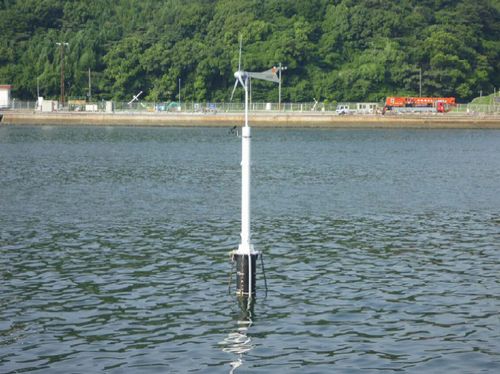
Copyright Kyoto University, Sasebo Heavy Industries Co., Toda Corp., Nippon Hume Corp.
Kyoto University and three Japanese manufacturers: Toda Corp. (a major general contractor), Sasebo Heavy Industries Co. (a transport machine manufacturer) and Nippon Hume Corp. (a hume pipe manufacturer), announced on September 8, 2009, that they had jointly developed in Sasebo, Nagasaki Prefecture, the world's first hybrid spar-type platform consisting of steel and pre-stressed concrete (PC) for floating wind turbines.
The effectiveness of the platform was verified by a demonstration test on the ocean using a one-tenth scale model. The platform can be constructed in a short period of time by using precast PC parts and utilizing existing shipyard docks.Also, there is no need to use a large crane ship for the construction, and once it is constructed, the platform can be towed and installed quickly. Moreover, it is comparatively easy to relocate the platform just by changing the tether position. These aspects enable flexible use of the platform in response to future changes in wind conditions at the installation site or to meet changes in energy demand.
Taking advantage of these characteristics, the platform is expected to be used not only in remote islands but also at large wind farms in suburban areas close to big cities. Exports of the platform to neighboring countries are also anticipated.
Sasebo Heavy Industries Co. official website
http://www.ssk-sasebo.co.jp/ssk/us/home/
Toda Corporation official website
http://www.toda.co.jp/english/
Department of Civil and Earth Resources Engineering, Graduate School of Engineering, Kyoto University,
http://www.ce.t.kyoto-u.ac.jp/en/
Posted: 2009/11/21 06:00:15 AM

Related
"JFS Newsletter"
- 'Yumekaze' Wind Turbine Project Connects Metro Consumers and Regional Producers: Seikatsu Club Consumers' Co-operative
- Shaping Japan's Energy toward 2050 Participating in the Round Table for Studying Energy Situations
- Nishiawakura's Initiative for 100% Energy Self-Sufficiency, and a Municipal ICO Scheme
- Actions Toward 100% Renewable Energy in Japan
- Sustainable Community Building in Shimokawa: Recycling-Oriented Forest Management Enabling Permanent Use of Forest Resources
Related
"Popular Articles"
- Current Status of Renewable Energy in Japan (2015)
- Offshore Wind Farm Withstands Great East Japan Earthquake and Tsunami
- Current Status of Renewable Energy in Japan (2014)
- Geothermal Power: Japan Has World's Third Largest Geothermal Reserves, 60 Percent of Which Can Be Developed
- Tokyo Plans to Increase Renewable Energy Ratio to 20% by 2024


Some rights reserved. This work is licensed under a Creative Commons Attribution-NonCommercial-ShareAlike 3.0 License.