


November 13, 2009
Gene Identified that Allows Rice to Grow in Flood-Prone Areas
Keywords: Ecosystems / Biodiversity University / Research institute Water
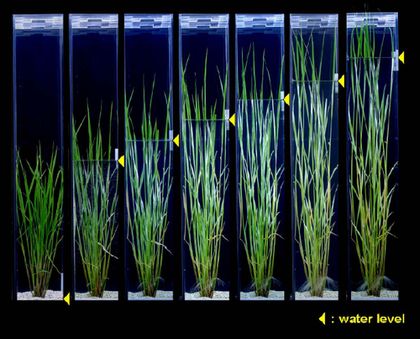
Copyright Nagoya University Graduate School of Bioagricultural Sciences
A joint research team comprised of the Nagoya University Graduate School of Bioagricultural Sciences, Kyushu University, the National Institute of Agrobiological Sciences and Riken Plant Science Center announced on August 20, 2009, that they had succeeded in identifying the gene and molecular mechanism that enable deepwater rice to survive sudden flooding without drowning.
When deepwater rice plants are submerged in water, ethylene gas accumulates in its hollow stems. As the ethylene diffusion rate in water is one 10,000th of that in air, it physically traps ethylene gas in the stems. The deepwater rice has the genes SNORKEL1 and SNORKEL2 in its chromosomes. These two genes respond to ethylene, activating a growth signal to begin elongation. Non-deepwater varieties of rice do not have these two genes and will not elongate when submerged.
This research finding is expected to contribute to the further development of high-yielding deepwater rice varieties that can grow in regions of the world that suffer from heavy flooding.
New Rice Strain Being Developed in Japan to Cope with Global Warming (Related JFS article)
http://www.japanfs.org/en/pages/027050.html
Bioscience and Biotechnology Center, Nagoya University
http://www.agr.nagoya-u.ac.jp/~nubs/index-e.html
Posted: 2009/11/13 06:00:15 AM

Related
"JFS Newsletter"
- 'What Are the Roles of Zoos Today?' - Interview with Director of the Popular Asahiyama Zoo
- Nishiawakura's Initiative for 100% Energy Self-Sufficiency, and a Municipal ICO Scheme
- 15-Year Integrated Forest Environment Education in Shimokawa, Hokkaido to Support Sustainable Forest Management
- Fifth Contest to Award Excellent Environmental and Social Practices by Junior High, High School Students
- Increase Revenues without Increasing Catches -- How the Sustainable Sakura Shrimp Fishery in Suruga Bay Does It
Related
"Popular Articles"


Some rights reserved. This work is licensed under a Creative Commons Attribution-NonCommercial-ShareAlike 3.0 License.