


September 24, 2009
Daichi wo Mamoru Kai Opens Noodle Soup Shop Using Domestic Rice
Keywords: Food Manufacturing industry Non-manufacturing industry
Copyright Toko. Co.
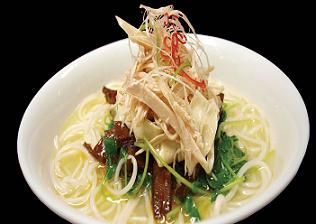
Toko. Co., a subsidiary of Daichi wo Mamoru Kai, Co., which is known for its organic food delivery network, opened the noodle soup restaurant "Yun Nan Rice Noodles" in Yotsuya, Tokyo, on June 17, 2009. The restaurant serves mixian rice noodles made form domestically grown rice. While ramen, another type of noodle soup, is considered one of the most popular dishes in Japan today, its main ingredient, wheat flour, is mostly imported. The restaurant, therefore, hopes to help increase rice consumption by serving rice noodle dishes.
Consumption of bread and pasta has been rising, particularly among younger generations, in recent years, whereas consumption of rice has been declining. Japan's annual rice consumption per person was 115 kg in 1960; however, it had decreased to almost half that, 61.4 kg, by the year 2007. Furthermore, due to the rice acreage reduction policy of the government, rice fields are disappearing year after year, giving rise to concerns that the rice cultivation culture may also be disappearing.
Mixian, the rice noodle used by the restaurant, is a common, everyday food in Yunnan Province in China, where rice cultivation originated. In Japan, only imported mixian has typically been available. However, the use of custom-ordered machinery has enabled the restaurant to make mixian domestically.
The restaurant's medicinal broth-based soup contains no artificial flavoring and goes well with mixian. The noodle soups are priced from 680 yen (about U.S.$7.00), with various toppings to choose from. The menu also displays the food miles of each item, giving the customer an idea of how far the food has traveled. The restaurant plans to have three locations by the end of 2009 and 100 locations by 2019.
Daichi-o-Mamoru-Kai(Association to Preserve the Earth) No.36 (August 2005)
http://www.japanfs.org/en/mailmagazine/newsletter/pages/
027961.html
Posted: 2009/09/24 06:00:15 AM

Related
"JFS Newsletter"
- Fifth Contest to Award Excellent Environmental and Social Practices by Junior High, High School Students
- Coco Farm & Winery: An Amazing Model of Special Needs Students and Community
- Locally Produced Food in School Lunches----A Challenge by Nyuzen, Japan
- Seikatsu Club: Japanese Cooperative Managed by Members' Will to Confront Social Problems
- Increase Revenues without Increasing Catches -- How the Sustainable Sakura Shrimp Fishery in Suruga Bay Does It
Related
"Popular Articles"
- Yukiguni Maitake and Grameen Group Launching Joint Mung Bean Project in Bangladesh
- Japan's Food Self-Sufficiency Ratio Unchanged at 40% for 8 Years
- Food Pictograms Used at APEC SME Summit 2010
- Rental Organic Farm Provides Farmland for Housing Development Project
- Greenpeace Survey Ranks Five Top Japanese Supermarket Chains for Fish Safety, Finds Problems


Some rights reserved. This work is licensed under a Creative Commons Attribution-NonCommercial-ShareAlike 3.0 License.