


April 7, 2009
NIMS Develops Simplified Method to Recover Rare Metals from Urban Mine
Keywords: Environmental Technology Reduce / Reuse / Recycle University / Research institute
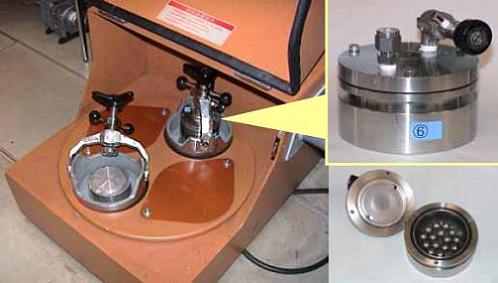
Ball mill : Copyright National Institute for Material Science
Japan's National Institute for Material Science (NIMS) announced that it had developed a new method which is easier to use in recovering rare metals from piles of used products, so-called "urban mine."
In the method, announced on November 26, 2008, discarded electric devices are shredded into pieces of a few centimeters in size before being put into a ball mill and ground, without undergoing disassembling and selection by hand.
Rare metals can be separated taking advantage of the physical properties of device's materials and joined parts.
By feeding large objects exceeding the ball mill's accepted maximum size limit, structural parts of the wastes made of plastics and aluminum are not ground and left in the form of plates, whereas junctions, ceramics and plating that contain rare metals, are pulverized into fine particles less than one millimeter in size. Through this process, each component can be obtained in a form to be treated easily in the downstream process.
This method, utilizing a ball mill, a simple piece of equipment widely used in conventional pulverization, basically requires no heat or water, and can be operated in urban area as a small size plant. NIMS considers this to be an optimal system for "urban mines."
- Production of "Urban Ore" from Used Electronic Equipment without Human Intervention
http://www.nims.go.jp/eng/news/press/2008/11/vk3rak00000017ja.html
Posted: 2009/04/07 06:00:15 AM

Related
"JFS Newsletter"
Related
"Popular Articles"
- New Nano-Bubble Technology May Help Dissolve Sludge and Improve Water Quality
- Japanese Firm Begins Development of Tidal Power Generation System
- Small Hydropower Generation System Developed for Use in Seawater, Weight Cut by Half
- Constructed Wetland Facility Established by Japanese University Purifies Livestock Farming Drainage
- Toyota CRDL Succeeds in World's First Artificial Photosynthesis Using only Water and CO2
Related
"JFS' Columns"


Some rights reserved. This work is licensed under a Creative Commons Attribution-NonCommercial-ShareAlike 3.0 License.