


February 21, 2009
Innovative Urban Transport System Saves Energy Using Rollercoaster Principles
Keywords: Environmental Technology Manufacturing industry Transportation / Mobility University / Research institute
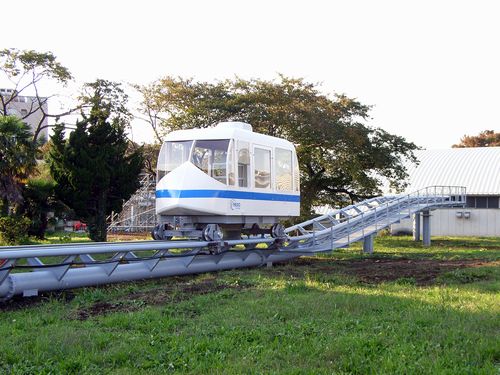
Copyright University of Tokyo, Senyo Kogyo Co.
The Institute of Industrial Science, University of Tokyo (IIS), and Senyo Kogyo Co. and its group company (the companies are specialized in the construction of amusement park facilities) announced in November 2008 that they have built a track line to test an energy saving urban transportation system, called "Eco-Ride," at the Chiba Experimental Station of IIS in Chiba Prefecture, Japan. The aim of the joint project is to develop an energy saving drive system using the height differences of rail tracks, as well as to develop a high-performance train and rail that produces less vibration and noise, by adopting an advanced coupling structure to prevent derailment.
The test track was constructed as a rail course about 100 meters long with a height difference of about three meters and a maximum downward slope of 7.4 degrees. A box-type vehicle will operate at 20 kilometers per hour (km/h) on the track to generate electricity using the forces of air resistance and the speed of the train. On commercial rail tracks, lift motors will be used at multiple places to move the train up slopes to gain potential energy using the same principal as a roller coaster. It will operate at an average speed of 20 kilometers per hour , with a maximum of 40 kilometers per hour.
The project has been in progress since the 2006 fiscal year, under the sponsorship of the New Energy and Industrial Technology Development Organization (NEDO), an independent government corporation. This transport system is aimed at traveling short distances of under 10 kilometers, and is expected to operate between mass-transit sites such as rail and subway stations and local transit systems such as minibuses and taxis.
In an estimated calculation, the energy consumption of this transport system is one-third the energy consumed by a bus. The construction cost is projected to be between 2 billion and 3 billion yen (about U.S.$22 million to $33 million), which is one-fifth the cost of monorail construction. The project launch is planned for 2012.
- Institute of Industrial Science, University of Tokyo (IIS)
http://www.iis.u-tokyo.ac.jp/index_e.html
- New Energy and Industrial Technology Development Organization (NEDO) official website
http://www.nedo.go.jp/english/index.html
Posted: 2009/02/21 06:00:15 AM

Related
"JFS Newsletter"
- Auto Sales Industry Cooperates to Tackle Social Responsibility: Examples from Yamagata, Japan
- 'Community Car Sharing' Supports the Bond of Mutual Aid
- Resident-Led Efforts to Secure Local Public Transport Systems
- Buy Flowers Downtown and Ride the Train for Free? A Look at Toyama's Creative Approaches to Being a Vibrant City in a Time of Depopulation
Related
"Popular Articles"
- Kakegawa Declares Itself a "Slow Life City"
- Car Ownership Rate for Japanese Households Decreases
- Toyama City Works Toward Compact City Utilizing Public Transportation
- Kanagawa Pref. Announces Concept Vehicle for Electric Bus with Low, Full Flat Floor
- Kyoto Tackles Mission of Becoming World-Class Bike-Friendly City


Some rights reserved. This work is licensed under a Creative Commons Attribution-NonCommercial-ShareAlike 3.0 License.