


Eco-business / Social Venture
August 4, 2003
Greening with Moss!
Keywords: Climate Change Eco-business / Social Venture Ecosystems / Biodiversity Non-manufacturing industry
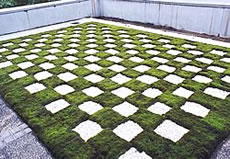
Copyright Moss Catch System Yamagata Co.
With the use of rice cultivation techniques, moss is cultivated on a mat made of tightly entangled rice roots. Only natural materials are used to produce the mat and no electricity or other energy is needed.
As it absorbs moisture and nutrients from the air, moss does not need soil to live. Because of its high water-retaining capacity, moss can survive even in drought conditions. Watering and fertilizing are not required. The moss mats are light in weight, so they place very little stress on the buildings to which they are applied. The company is promoting its product as a low-maintenance system to promote greenery, saying that the moss mats can be applied not only to roofs or walls of buildings, but also to roads, concrete river banks and dams, and sheet metal roofs of factories, etc..
Moss Greening to Curb Urban Heat Island Effect (Related JFS article) http://www.japanfs.org/en/pages/027204.html
Posted: 2003/08/04 09:22:01 AM
Japanese version

Related
"JFS Newsletter"
- Nishiawakura's Initiative Based on People Discovering Their Own Desires
- Learning from Pollution Experience, Kitakyushu Now Promotes Sustainable Society in Asia
- Seikatsu Club: Japanese Cooperative Managed by Members' Will to Confront Social Problems
- Toward a Sustainable Society and Economy -- Green Purchasing Network Celebrating 20th Anniversary
- Developing Rural Community-Based Economies to Preserve Prosperous Villages for Future Generations
Related
"Popular Articles"
- Japanese Company Launches Newly Developed Rice Husk Fuel Machine
- Photo-catalytic Titanium Apatite Air Filter Catches Viruses
- Suntory to Use 20% Lighter Plastic Bottle for Mineral Water
- Japanese Egg Producer Receives Ecofeed Certificate
- Shimizu Corp. to Construct First 'Zero-Energy' Building in Japan


Some rights reserved. This work is licensed under a Creative Commons Attribution-NonCommercial-ShareAlike 3.0 License.